Showing posts with label native american. Show all posts

Thursday, May 31, 2018

Bosque Redondo Memorial Commemorates 150 Years since the Treaty of 1868


I keep in touch with the happenings at the memorial at Bosque Redondo, NM through the museum association’s newsletter. I wrote about my somber visit to the site several years ago. I was terribly moved after visiting and talking with elders on the Navajo Reservation whose relatives had been forced to endure The Long Walk to Bosque Redondo.

The memorial has announced that Friday June 8th they will offer an opportunity for Navajo and Mescalero Apache visitors to shape the museum’s interpretation of their cultural history. On Saturday, June 9th visitors will have a chance to participate in a recreation of the Navajo return to the homeland to promote solidarity and reconciliation.

Also on Saturday, the 150th Treaty celebration will host cultural dances, respected speakers from tribal and state government, along with tribal elders sharing their oral traditions as they pertain to the hardships and resilience of life both during the reservation era as well as the post reservation era.  Traditional foods and artisans will be on site in support the event and the culture.

After the event, visitors will have the option to participate in a 6.5-mile walk/run, led by DCA, from Bosque Redondo Memorial to Fort Sumner High School in honor of the Navajo return to the homeland.  Upon arriving at the high school, visitors can choose whether to continue the 350-mile walk back to Window Rock, AZ or remain at the high school for refreshments.

To learn more call 575.355.2573

Information Provided by Museum of New Mexico Foundation

Tuesday, May 30, 2017

Visiting a New Mexico Pueblo: Laguna Pueblo Feast Day


Feast Days at the pueblos of New Mexico are special times full of family, feasting and ceremony. Usually feast days are open to the public. And, as I found out, feast days are great opportunities to enjoy Native American culture, pueblo-style.

What is a Feast Day?
According to the Indian Pueblo Cultural Center in Albuquerque, “Feast Days” at each of the Pueblos are named after the Pueblos’ patron saint. The Pueblos open up their respective Feast Days to the public where visitors can view the reverent dances and songs offered on those days.

Feast Days bring tribal members together to renew their culture, language and native religion. On those days, families prepare food for the many invited visitors coming through their homes, and participate in the activities taking place on their Feast Day. Pueblo Feast Day Dates do not change and are held on the same date each year. List of Pueblos and Feast Days

What is a Feast Day Like?
I had never attended a feast day and heard about the Feast Day at Laguna Pueblo, 45 miles west of Albuquerque. The pueblo, visible from I-40 had always intrigued me.

With earth colored adobe homes dotting the hillside and a white historic mission church at the top of the hill, Laguna Pueblo looked more like a scene out of old Mexico than what you might expect to see while driving the Interstate. Laguna is home to the Ka-waikah people and, like the other pueblos, have their own government and rules for visitors.

St. Joseph Church at Laguna Pueblo
September 19th is the Feast Day of St. Joseph, the patron saint of Laguna Pueblo. You can see the beautiful whitewashed adobe St. Joseph's church from the highway. When you attend the Feast Day, you may visit the church.

The feast day, the year I went, was on Sunday and took place 10am - 8am. I arrived around 11 a.m. and found plenty of places in the dirt parking lot on the hillside behind the church. People were parking alongside the road and at their relative's homes.

The first thing I noticed were rows upon rows of colorful tents lining the areas around the church. I parked (free) and started walking along the dusty pathway. I
I enjoyed looking at all the booths. Families were selling roasted corn from the backs of their pick-up trucks. The corn, grey with ash, looked as though it had been roasted in a pit.

As I made my way up the hill, I noticed that there were quite a few jewelry vendors from Kewa Pueblo (formerly Santo Domingo) known for their inlaid shell and heishi. There were "Diné curly fries", hamburger stands and sno-cone vendors. I had a sense I would not go hungry!

It was fun to see what each booth offered. There were dime toss games for children, quite a bit of pottery from Acoma, Macaw feathers from Central America, wonderful home made pies and horno (oven) bread.

The main booths were located along two streets near the church. A Laguna pottery vendor welcomed me and suggested I visit the church, founded in 1701. I did so and said a prayer for the success of the pueblo's harvest. I noticed beautiful traditional painting along the walls, and old, creaky wooden pews that must have been there for many years. I took a photo of the church, with permission, and left a donation.

It was getting hot and I was glad I brought water. Around the stone and adobe homes, there were many people. Inside, families were serving their invited guests, too many to fit inside the home.

Ceremonial Dances
I heard the beat of drums and wandered closer to the main plaza. Just outside, in front of a home there were feathered Eagle Dancers. I watched the dance and then headed over to see what was going on in the plaza. It wasn't time for a dance yet. There were chairs lined up for the local people. Visitors could watch, respectfully from above, if they remained behind the local people.

As I wandered the booths, I noticed dancers, in traditional dress, shopping for food and for more items of traditional dress. I especially enjoyed the fact that this was not a tourist-oriented event. 95% of the people there were Native American. I saw friends from Zuni and Acoma there.

Laguna Pottery
I collect pottery and was looking for some Laguna potters. I asked each pottery vendor where they were from and oddly, most were from Acoma. I know that Laguna and Acoma people have had a close relationship over the years but I still had hoped to purchase a piece of Laguna pottery. In speaking with a young Laguna woman who had a few pieces of pottery to sell, I found out that there were not many people at Laguna making traditional pottery. She was teaching pottery and wanted to revive the art. Next to her, one of her students was wrapping up two huge pottery jars for a collector. Other than these two booths, I didn't encounter many local people who made pottery.

I ended up purchasing a small Jemez pot from Geraldine Toya. She had a gorgeous wedding vase pot which was a bit out of my price range. Her pots are all made in the traditional way and she and her husband use natural pigments and paints.

Geraldine Toya and her beautiful pottery.
The amazing wedding pot is on the left.
Interestingly, you can see their work, in much larger form, along the Albuquerque Sunport road.

I had met Laguna potter, Michael Kanteena, as he presented his art for us at the Petroglyph National Monument years ago and hoped to see him at the feast day. Unfortunately he was not there.

I stopped by the Indian Arts Center store just off the Interstate, near the gas station and asked about Laguna pottery. The owner explained, as did the pottery teacher, that there were not many potters in Laguna. She had some older pottery available for sale to collectors. Also at the Indian Arts Center, you'll often find fry bread and Indian tacos for sale.

Worth a Stop.
When You Go
Feast days are opportunities to visit the Laguna Pueblo as it is a time that visitors are welcomed. Although each small town that makes up the Pueblo has a feast day, the best one to attend is September 19th, as all the villages celebrate the Feast of St. Joseph and gather at Laguna for dances after a Mass at the San José Mission Church.

You'll be spending the day outdoors so wear sunscreen, a hat and carry (or purchase) water.

Bring cash for food and your arts and crafts purchases. While some vendors took checks, and a very few took credit cards, most expected purchases to be made with cash.

More Information - Laguna Pueblo Website

Tuesday, November 15, 2016

Celebrate Native American Culture Through Travel: New Attractions and Programs


November is National Native American Heritage Month, and the American Indian Alaska Native Tourism Association (AIANTA) and the National Park Service are encouraging travelers to celebrate American Indian culture throughout the country by visiting National Parks with special connections to the Native Heritage in their respective locations.

Through collaborations between tribes and public lands, tourism helps Indian Country link its historical interpretations to landscape, showcasing that authentic tribal stories and perspectives are intertwined in the fabric of American history.

During 2016, the centennial of the National Park Service, a number of park-tribal collaborations debuted, giving park visitors new perspectives on history, community, and the land.

Where should you go? Here are a few ideas the Parks and AIANTA put together:

  • Glacier Bay National Park and Preserve:
    Twenty years of relationship building and collaboration between the Hoonah Indian Association (the federally recognized tribal government of the Huna Tlingit) and Glacier Bay National Park and Preserve was celebrated at the opening of the Huna Tlingit Tribal House (Xunaa Shuká Hít) on August 25, 2016. The Tribal House provides a venue for ceremonies, workshops, camps, and tribal meetings. Through mentoring, apprentice opportunities, and interpretive programming, the Huna Tlingit Tribal House ensures that Huna Tlingit culture, language, and history will be passed on to current and future generations.
     
  • Desert View Watchtower:
    At the Desert View Area and Watchtower in Grand Canyon National Park, the expertise and voices of the park’s Inter-tribal Advisory Council and park staff along with support from the American Indian Alaska Native Tourism Association are launching a new vision and model for interpretation and tribal engagement. Park visitors can now engage with First Voice cultural demonstrators and interpreters while tribal youth can take part in internship and employment opportunities offered by the park. Over time, an inter-tribal heritage center will be developed where visitors can learn more about neighboring tribes and get information for visiting tribal reservations.
     
  • Acadia National Park:
    In Acadia National Park, weekly Cultural Connections presentations spotlight the heritage and history of the park and the region. This year, Hawk Henries, member of the Nipmuck Tribe, brought a tribal voice to the series, featuring storytelling and musical performances on his hand-carved eastern woodland flutes.
     
  • Crater Lake National Park:
    The Klamath Tribes of Oregon consider Crater Lake to be a place of important spiritual significance. When the Britt Orchestra and the staff at Crater Lake National Park began planning a special centennial concert in the park, they reached out to the Steiger Butte Drum troupe, made up of members of the Klamath Tribes, to play a prominent role. On July 29th and 30th, the Orchestra, Drum troop, and a 50-voice choir debuted an original composition, Natural History, to an enthusiastic crowd of park visitors.
     
  • American Indians and Route 66
    The Native American experience of Route 66 is highlighted in a new website and travel guide, created in partnership by AIANTA and NPS. While the guide includes native history and points of interest along the route, it also informs travelers about genuine cultural experiences available today. Compiled with assistance from many tribes along the route, “American Indians and Route 66” gives travelers a more complete picture of the famed journey.

You’ll find that traveling through Native cultural areas and reservations has become even more open and welcoming to visitors. Organizations such as AIANTA are busy promoting Native tourism throughout the United States.

Wednesday, November 2, 2016

Holiday Wine Tasting and Pop Up Wine Sale at Tulalip Resort, Washington

Earlier this year I had the pleasure of spending time at the beautiful Tulalip Resort just north of Seattle. The Native art, the warm hospitality and the beautiful rooms are enough to entice you to visit. But wine lovers now have another reason.

Tulalip Resort Casino’s Sommelier Tom Thompson is extending an invitation to all wine lovers and holiday gift givers to the Resort's annual Taste of Tulalip Holiday Wine Sale. The sale will feature over 130 bottles of wine from around the globe, and will run from Monday, November 21 through Wednesday, November 23 from 4 p.m. - 9 p.m. each day. During the sale, guests can sample a selection of wines they might not have otherwise ever tried...and can purchase it on the spot!

While shopping for the perfect gift or something for the home cellar, guests can also select from pre-made or made-to-order gift baskets, some of which includes Taste of Tulalip commemorative plates, logo stemware, wine charms, and one or all seven vintages of the Taste of Tulalip Honorary Winemaker wines in Tulalip’s annual featured artist etched bottles. The bottles contain juice from some of Washington’s top winemakers, such as Betz Family Winery, Sparkman Cellars, and Côte Bonneville, to name a few.

For a sneak peek, a few star lineups being offered by Sommelier Tom Thompson during the sale include: Leonetti Cellars, Quilceda Creek Vintners, Château de Beaucastel, Marchesi de' Frescobaldi, Molly Dooker Wines, CIRQ, Kosta Browne, Silver Oak, Coup de Foudre Wine, and Harlan Estate.

The Taste of Tulalip Holiday Wine Shop will take place in the Resort’s Chinook Rooms 1 and 2. 

For more information about the Tulalip Casino Resort or Holiday Wine Shop, visit tulalipresort.com.

Monday, September 26, 2016

President Obama Signs NATIVE Act - A Boost to Tribal Tourism


President Barack Obama signed S. 1579, the Native American Tourism and Improving Visitor Experience (NATIVE) Act Friday.  The Act requires the Departments of Commerce, the Interior, and other Federal agencies with recreational travel or tourism functions to update their management plans and tourism initiatives to include Indian tribes, tribal organizations, and Native Hawaiian organizations.

Sherry L. Rupert, American Indian Alaska Native Tourism Association (AIANTA) Board President, said "this is an incredibly important day for Indian Country tourism, the beginning of an important collaboration between the federal, tribal and nonprofit sectors to strengthen and grow cultural heritage tourism in the U.S.  We thank the President for signing the bill, and Senators Brian Schatz (D-Hawai'i) and John Thune (R-South Dakota) and Representative Markwayne Mullin (R-Oklahoma) for shepherding the legislation through Congress."

Tourism in the United States and in Indian Country is one of the largest and fastest growing sectors of U.S. economic development and job creation.  International tourism to Indian Country grew 181% from 2007 to 2015, resulting in $8.6 billion in direct spending, according to U.S. Department of Commerce figures.

"This law will empower native communities to tell their own stories and build their own economic opportunities, said Senator Brian Schatz. "Visitors are increasingly seeking out a more authentic and historically rich travel experience, and there is nothing more authentic and unique than the cultural tourism experience our native communities provide."

"This is a good, common-sense bill that will have a real impact in tribal communities throughout the country, including the Lakota, Dakota, and Nakota nations in South Dakota," said Senator John Thune.

The NATIVE Act will require federal agencies with tourism assets and responsibilities to include tribes and native organizations in national tourism efforts and strategic planning. It will also provide American Indian, Alaska Native and Native Hawaiian communities with access to resources and technical assistance needed to build sustainable recreational and cultural travel and tourism infrastructure and capacity in order to spur economic development and create good jobs.

Joining the originators of the bill, Senator Schatz, and Senator Thune, the bipartisan co-sponsors of the NATIVE Act in the Senate were Jon Tester (D-Mont.), Lisa Murkowski (R-Alaska), Tom Udall (D-N.M.), Dean Heller (R-Nev.), Al Franken (D-Minn.), Mike Rounds (R-S.D.), Heidi Heitkamp (D-N.D.), John Hoeven (R-N.D.), and Gary Peters (D-Mich.).  The bill passed the Senate in June. 

Joining Markwayne Mullin (R-Okla) in House co-sponsorship were Dina Titus (D-NV), Don Young (R-Alaska), Kristi Noem (R-S.D.), Tom Cole (R-Okla.), Betty McCullum (D-Minn.), Mark Amodei (R-Nev), Kevin Cramer (R-N.D.), and Jared Huffman (D-Cal.).  The bill passed the House last week. 

"The NATIVE Act is a strong piece of legislation that will drive economic growth not only in Native lands and cultural attractions, but also for communities in every corner of the country," said U.S. Travel Association President and CEO Roger Dow. "We are pleased to see our government prioritize a measure to expand travel and tourism promotion and attract more international visitors, whose trips often have a tremendous positive ripple effect on the surrounding local economy."

Supporters of the legislation included U.S. Travel Association, American Indian and Alaska Native Tourism Association, Southeast Tourism Society, Western States Tourism Policy Council, National Congress of American Indians, Alaska Federation of Natives, and the Native Enterprise Initiative of the U.S. Chamber of Commerce.

Support also came from tribes and tribal coalitions around the U.S, including the Intertribal Council of the Five Civilized Tribes. Bill Anoutubby, Governor of the Chickasaw Nation of Oklahoma, said he wished to thank the legislative sponsors, especially Congressman Markwayne Mullin, for the opportunity to work more closely with federal agencies on tourism.  "The NATIVE Act will help Oklahoma and the Chickasaw Nation continue to strengthen its robust tourism efforts, and for many other tribes across Indian Country, it will create essential relationships with our federal partners and links to audiences across the U.S. and the globe."   

Source: AIANTA Press Release

Wednesday, September 21, 2016

American Indian and Alaska Native Tourism: Opportunities to Explore Native Life and Lands


I recently had the pleasure of attending the American Indian Alaska Native Tourism (AIANTA) Association national conference in Washington State. I came away with news, information and experiences that will inform and entice travelers who love exploring history, culture and natural beauty. Native tourism opportunities are growing, native hospitality is welcoming and the access visitors have to native lands and people is much more open that you might realize.

Tulalip Resort Casino Surprises
As you drive north of Seattle you’ll see a hotel and casino complex at Tulalip, just off I-5. If you aren’t a gambler you might pass it by. At least that is what I always did. Attending the AIANTA conference at the Tulalip Casino Resort conference center opened my eyes to the beauty of the hotel, the impeccable service and the history of the Tulalip tribes.

As you arrive at this AAA Four Diamond hotel, you’ll see a large Native canoe, a water feature. Inside the lobby you are greeted by two-story high locally carved totems. Throughout the luxurious hotel you will find Northwest Coast Salish artwork and textures. The resort has undergone a recent renovation. The rooms have state of the art electronics, amazingly comfortable beds and a frequently lauded shower with three adjustable heads.

Yes, there are modern comforts, but the hospitality is markedly Native. The Tulalip Tribes is a federally recognized Indian tribe located on the Tulalip Reservation, which includes the resort-casino. Reservation boundaries set by the Point Elliott Treaty of 1855 gave a permanent home to the Snohomish, Snoqualmie, Skykomish, Stillaguamish, and related tribes.

We dined on locally sourced, Native inspired foods… salmon, berries, corn, beans and squash (the three sisters). All were prepared with attention to detail and with interesting sauces and seasonings.

Close by is the The Hibulb Cultural Center of the Tulalip Tribes, a beautiful center with full-sized longhouse and interactive displays. It was the first Tribal facility certified by the state of Washington. Also within walking distance of the hotel is great shopping – The Seattle Premium Outlets.
Learn about the people of the Tulalip Tribe
at the Hibulb Cultural Center
I’ll be writing more about this beautiful hotel, the restaurants and the Tulalip people in upcoming articles. I was impressed and I am sure you will be too. The lobby art, alone, is worth a visit next time you are in the area.

Discovering Native Country – Where to Start
At the conference Native tourism leaders from across the United States came together to share and learn. We heard that international visitors, especially those from China, want to experience authentic America.

So where should the average traveler with a desire to experience Native culture and land start? You might get some ideas from exploring this years’ AIANTA Destination Award Winners.

The Tribal Destination of the Year was awarded to Icy Strait Point, the Huna Totem Corporation. Icy Strait Point is Alaska Native owned-and-operated, with all profits directly supporting the community of Hoonah, Alaska’s largest Native Tlingit village. You may have heard of this area from the TV reality series, Alaskan Bush People. And, by the way, the Browns don’t live in the bush year ‘round!
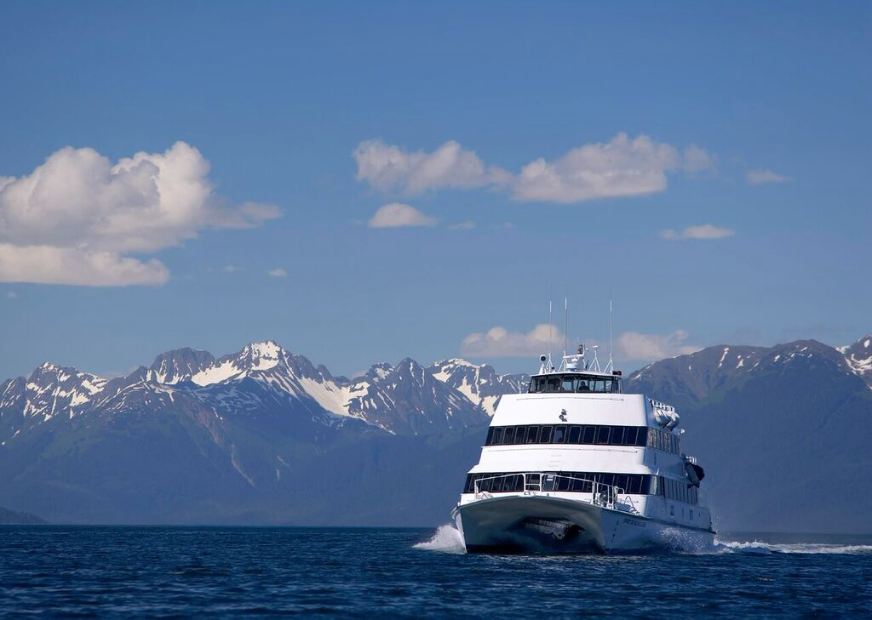
Icy Strait Point offers small ship whale
watching excursions. (Courtesy: Icy Strait Point)
Other Icy Strait Point tours take you
in search of bears. (Courtesy: Icy Strait Point)
Icy Strait Point is a frequent stop for cruise ships and now that they have a dock, even more visitors are stepping ashore to choose from 20 + tours and experiences. You’ll visit a 1912 salmon cannery and museum, nature trails, and even a beach. Chichagof Island is home to more brown bears than humans, eagles soar overhead and whales are regularly seen just offshore. You can take an ATV trip into the rain forest or soar above it via ziprider. It’s an exciting place that is truly Alaskan. I’d recommend putting it on your itinerary when cruising Alaska.

Not all Puye Cliffs tours
require ladder climbing but
this one did!
The Best Cultural Experience was awarded to Puye Cliffs, on the Pueblo of Santa Clara just north of Santa Fe, New Mexico. Your tour guide at Puye will be from the Pueblo, a great way to meet a Native person with ancestors who may have lived in the dwellings you are exploring.

Puye Cliffs was home to 1,500 Puebloans who lived, farmed and hunted game there from the 900s to 1580 A.D.

You can walk along the cliff and cave dwellings and take a ladder down into a kiva. The welcome building and small museum is housed in an original Harvey House. But the most enjoyable part for me was listening to the personal stories of the guides as they described life at Puye Cliffs and pointed out things we might have overlooked. And the view of the high desert from the top? Amazing.

Puye Cliffs offers special events too. October 15th is their next Earth and Sky Weekend. Because the site is on the Pueblo, you might experience closures for ceremonial reasons (or even dangerous weather) so it is good to call ahead and read their website.

Light streams into the art-filled
lobby at the Buffalo Thunder Resort.
The stained glass depicts Pueblo dancers.
Last but not least, the award for Excellence in Customer Service was awarded to Tina Whitegeese representing Hilton Buffalo Thunder Resort, also north of Santa Fe, New Mexico. I’ve had the pleasure of staying at Buffalo Thunder, on the Pueblo of Pojoaque. It’s a Native art-filled hotel with more than 400 pieces of pottery, art, glasswork and sculptures. In addition, every room offers hand-designed furnishings and work by local artists, including Pueblo of Pojoaque Former Governor George Rivera.

It’s a beautiful pueblo-inspired resort with high desert views. One evening as we enjoyed cocktails on an open rooftop, we watched a storm come in from the west. Looking out over the desert expanse was a beautiful and uniquely New Mexican experience.

You’ll have plenty to do while you’re there. The golf course, full service spa, a variety of restaurants and, of course the casino, draw visitors. But what you’ll remember are the people and the Native hospitality.

The Native American Tourism and Improving Visitor Experience Act
While at the conference we heard good news for Native tourism. The Native American Tourism and Improving Visitor Experience (NATIVE) Act (S. 1579) had passed both the House and Senate.

The bill allows tribal communities to be included in federal agencies’ tourism management programs. Sherry L. Rupert, AIANTA Board President announced, “This legislation will forever impact the ability of our nation’s tribes to promote their true and authentic selves through tourism. It will strengthen Indian Country economic development, cultural sustainability and accelerate the progress tribes have made in international and domestic tourism.”

According to the National Travel and Tourism Office, overseas travelers who visit Indian country stay in the United States longer, visit more cities and states, use more domestic travel options, and visit more National Parks, small towns, museums, and cultural and ethnic heritage sites in comparison to all other overseas visitors.
When it comes right down to it, Native people
and their warm hospitality is what makes a visitor's experience.
These people from as far away as Alaska made my
AIANTA conference experience memorable.

Native Tourism Resources
AIANTA Members – Describes Native tourism opportunities across the U.S. with links to their websites.
Native America Travel – AIANTA website for visitors

Wednesday, September 7, 2016

Pacific Northwest Tribes join Spiritual Canoe Journey on the Missouri River in Support of the Standing Rock Sioux

Gatherings on the water of the indigenous peoples of the coastal Pacific Northwest are beautiful traditions. People paddle between Oregon, Washington and Canada for such events as the annual Canoe Journeys in the Pacific Northwest.

The paddle this year was to Nisqually. Next August, the We Wai Kai and the We Wai Kum nations will welcome canoe families from around the world to Quadra Island and Campbell River, B.C. These are celebratory and ceremonial events that canoe families look forward to each year.

But today, there is an even more important reason for the canoe families to gather. Families from as far away as Alaska have gathered on the banks of the Missouri River and have launched on a two-day journey. This is a peaceful, spiritual paddle down the river through Bismarck in protest of the Dakota Access Pipeline being built through and near tribal lands and river in North Dakota. They are paddling in support of their Standing Rock Sioux relatives.

Canoe Families from Nisqually, Puyallup, Muckleshoot Tribes of Washington, Warm Springs and Coeur d’Alene, Idaho, and Alaska, are joining the Standing Rock Sioux and thousands of other paddlers on the Missouri.  Read more at http://indiancountrytodaymedianetwork.com/2016/09/05/idle-no-more-announces-washington-paddle-standing-rock-2016-165684

As has been repeated over and over these past weeks, “Water is Life.” As I delve into the issue, I have found many instances of pipeline leaks, oil train leaks and leaks from oil carrying ships into the waters we all depend on. It is our Native people who are leading the environmental charge. We all need to lend them support and well wishes in this spiritual journey.

In New Mexico, people at Pojoaque Pueblo just north of Santa Fe are gathering in support of the Standing Rock Sioux. 

I remain perplexed as to why the mainstream media does not seem to be covering this important event. 

“From the Salish Sea to the Missouri River ~ Standing with the Standing Rock Sioux!”

Follow these hashtags on social media and look for opportunities to lend your support: 
#NoDAPL #WaterIsLife  
  
More information on the paddle is on this Facebook event page

How to help the Standing Rock Sioux.  

Friday, September 2, 2016

Visit with Noted Native American Designers and Artists at Washington's Tulalip Resort


She Who Watches
Cast Glass on Copper Base
by Lillian Pitt
If you are in the Seattle-Everett area this month you will have a unique opportunity to meet celebrated Native American artists, see examples of their work and learn more about Native American tourism destinations. The public is warmly welcomed to the exhibit area at the Tulalip Resort Casino conference space just 30 minutes north of Seattle.

The American Indian Alaska Native Tourism Association (AIANTA) is holding the 18th Annual American Indian Tourism Conference hosted by the Tulalip Tribes of Washington at the Tulalip Resort Casino, September 12 – 14, 2016. In addition to speakers and workshops, the conference hosts an exhibit area where tourism businesses and artists share their work with the public.

The public is welcome to drop by and view the exhibits and artists. A few of the artists are profiled below, but more will be present. “The arts are an important part of Indian Country tourism,” says AIANTA Executive Director Camille Ferguson. “Artists are often cultural ambassadors for their nations as they travel to various art shows to sell their works.”

Dorothy Grant
Internationally renowned fashion designer and traditional Haida artist Dorothy Grant’s strong connection to her culture and Haida identity has been the driving creative force and her foundation as a contemporary fashion designer for over the past thirty-two years. Her work was recently seen on the runway at the Santa Fe Indian Market. There are few designers in Canada that are manufacturer, a wholesaler, and have had their own retail store front, Dorothy Grant is one of those few. She is known for her Haida inspired formal wear, purses and scarves.

Jacob Laktonen, is a Sugpiaq/Alutiiq artist from Kodiak, Alaska. He is strongly influenced by the traditional carving of his Alutiiq ancestors. Jerry combines his talent with painstaking research to produce stunning masks and ceremonial paddles. Although he did not begin carving seriously until the age of 45, his work drew the attention of the Smithsonian Museum, which bought his first mask for their gift stores

Lois Chichinoff Thadei is Aleut, born into a Tlingit and Haida community in Southeast Alaska. Thadei's work is dependent on the seasonal cycles, when different materials become available in nature: winter is for weaving Ravenstail from cedar bark and grasses and firing pottery in her home studio.

Lillian Pitt
Lillian Pitt creates contemporary works of fine art that delight today’s art lovers and honor the history and legends of her people. Her works have been exhibited and reviewed throughout the Pacific Northwest, nationally and internationally, and she is the recipient of numerous awards and distinctions. Lillian's most recent public works are featured at the Vancouver Land Bridge, one of the seven Columbia River “confluence” projects, designed by internationally renowned architect Maya Lin.

The exhibit area is open Tuesday, September 12 from 8:00 a.m. until 5:00 p.m. and Wednesday, September 13 from 8:00 a.m. until 5:00 p.m. For more information, visit the AITC website, http://www.aitc2016.com or call AIANTA at 505.724.3592.

Address:
10200 Quil Ceda Blvd.
Tulalip, WA 98271

Friday, August 26, 2016

Experiencing a Site of Conscience: Bosque Redondo and the Navajo Long Walk

Many have not heard about "The Long Walk" and Bosque Redondo at Ft. Sumner, New Mexico. Sometimes it is easier to forget painful chapters of our past.
 
I volunteered for five years with the traditional Navajo elders on the Navajo Reservation. Through the Adopt a Native Elder program I had the pleasure of meeting and talking with elders as old as 100 years during my twice-yearly food runs. We did bring clothing, food and medical supplies. But the Adopt a Native Elder Program is about building bridges of hope and understanding between our two cultures. 

So we talk and learn about each other. I have been moved by their mentions of "The Long Walk," a forced relocation from their homeland in Arizona to the Bosque Redondo area of New Mexico. Some of the elders recalled their older family members talking about the relocation with great sadness.
 
Bosque Redondo Museum and Grounds
I also had the pleasure of seeing unusual brightly colored weavings done by some of the Navajo women. The weavings were called "Germantown" style. I was told that the Navajo only used the commercial yarns to weave when the natural yarn and dyes were unavailable. Before the Navajo were relocated to Bosque Redondo, the beautiful Churro sheep they had used for wool yarn were destroyed.

I was both horrified and perplexed by what I heard. I was determined to find out more and wondered why many people had not heard about "The Long Walk." Or was it that people didn't want to talk about what they knew? I decided that I needed to go to the memorial site at Bosque Redondo, New Mexico, both to find out more, to see what the area looked like and to try and piece together what I had heard about "The Long Walk."  

Brief History of The Long Walk
Stories about "The Long Walk" have inconsistencies. Some say that the U.S. Army had experienced hostilities from groups of Apache and Navajo people and needed, somehow, to pacify them. Others say that there were valuable minerals to be mined on the lands. For whatever reason, it was decided that the Native people were a threat and should be moved. The Mescalero Apache were moved to the Bosque Redondo area and then the Navajo. I was told that the Navajo, who lived on vast lands, decided to hide so that they could not be captured and relocated. Kit Carson and the U.S. military retaliated by destroying their homes, fields and livestock. With no food, no means of survival and having no shelter, the Native people ended up coming to forts out of necessity. They were then banded together and relocated, being promised at the end of the journey, fertile farmland.  

This ‘scorched earth’ campaign of Carson’s “designed to starve the Navajo into submission” would be aptly called by the Navajos “The Fearing Time.” (Bosque Redondo Memorial Website History)

The walks started in January 1864. Groups of Navajo led by the Army were relocated from their traditional lands in eastern Arizona Territory and western New Mexico Territory to Fort Sumner in an area in the Pecos River valley. The journey was 450 harsh miles and many died during the trek.

Ultimately, by mid-1865, between 8,000 and 9,000 people were settled on an area of 40 square miles. After much hardship, the fleeing of the Apache people, and finding that the saline condition of the Pecos River flowing through the Bosque was not conducive to growing corn, beans and squash, the Navajo negotiated a treaty. The Treaty of Bosque Redondo between the United States and many of the Navajo leaders was concluded at Fort Sumner on June 1, 1868. The treaty provided for a return to the Navajo lands, supplies so that they could re-establish farming, compensation to tribal members, education for the children and provisions to protect the Navajo from having something like this happen in the future.
Treaty Rock is a good place to leave an offering.
Navajo Ghost Beads
Going to the Memorial at Bosque Redondo
Not many people travel to the Bosque Redondo Memorial at Fort Sumner State Monument. The Navajo people don't want to go as it represents a very dark chapter in the history of their people. The rest of us may not know about "The Long Walk," and if we do, we find that the area is very out of the way. You have to want to learn more and to experience the area to drive out to the memorial. It is off the beaten tourist path.

On a sunny autumn day I headed from Santa Fe, south on 285 south through Clines Corners and east on I-40 through prairie land. The drive was primarily on lightly traveled roads and so it gave me time to reflect on the Navajo people, their love of their land and four sacred mountains. How could anyone believe they had the right to move the Navajo? And, as I drove, I considered how it would be to walk through this high desert with no shelter, open to the elements. Men, women, children and elders endured this walk.
This painting is a moving depiction of the
horrors of the Long Walk across open high desert.
At Santa Rosa, New Mexico, I turned off the interstate and headed for the little town of Fort Sumner. The area was open, there were few trees except for cottonwoods and there were some large ranches. It felt like west Texas. It was so different from the Navajo's homeland dotted with herds of sheep and surrounded by the four sacred mountains. The land and their lives and culture are so intertwined. I could not imagine them apart from their lands.

My mood became more introspective as I neared Ft. Sumner. I had heard so much about the history there and it was all very dark. Ft. Sumner is an interesting small town with vintage buildings and a few historical landmarks. The legend of Billy the Kid seems to be the main draw with a commercial museum and gravesites. But I was focused on reaching the historic Ft. Sumner site and Bosque Redondo. Signs led me a few miles out of town through farmland (mostly alfalfa is being grown there). I reached a sign leading me into an area of cottonwoods and a building with a teepee shaped entrance.

In 1991, New Mexico State Monuments, the Museum of New Mexico, Navajo, and Apache leaders, began the creation of a memorial to truthfully acknowledge the history at Bosque Redondo. The Bosque Redondo Memorial opened at Fort Sumner on June 4, 2005, with New Mexican, Navajo, and Mescalero Apache leaders present. The memorial, designed by Navajo Architect David Sloan is shaped like a Navajo Hogan and an Apache teepee, and provides an interpretive trail and in-depth information about the history of Fort Sumner and Bosque Redondo Indian Reservation.  

At the Memorial
I had to realize, as I entered the memorial building, that the Navajo people no longer are in the area and most choose not to visit. I was greeted by a friendly Anglo man who proceeded to give a young couple from Dallas and myself an oral history of the area and "The Long Walk." He was knowledgeable, engaging and objective about the history.

I learned much from him including that the "Walk" was not one, but multiple treks along different routes. And I learned that corn could not be grown in the area once the people arrived due to water quality and an infestation of moths. So the military ended up trying to feed and clothe the people there, albeit poorly. I learned that the Apache and Navajo did not get along due to the difference in their lifestyles (the Apache were not farmers), and pictured that the encampment must have been a total disaster. Crops couldn't be grown, people didn't want to be there, the two tribes did not get along and for what purpose?

After the talk, I explored the grounds. You can take an audio tour as there are numbered stations on the memorial grounds. I was drawn to the Pecos River and found a nature trail along the water. I found peace along the river as I walked along the golden paths. I imagined the Navajo coming to the river for water.
The beauty of the bosque and river provided some peace
in an otherwise troubling setting.
On the grounds I found a reconstruction of the Fort Sumner ruins. The original fort was burned years ago and there is little that you can see from that era. Also on the grounds is a memorial to the treaty that the Navajo negotiated with the U.S. Government and a place where rocks have been placed that represent all the areas of the Navajo Reservation.

Not much is on the grounds but the feeling of despair remains. Aside from my walk along the river, I had the same feeling visiting those grounds as I did when I visited the remains of the Dachau concentration camp in Germany. That is a strong statement to make but it is the way I felt.
From the four corners of the Navajo Reservation, these rocks were brought.
The Navajo people still prefer not to return to this area.
The Visitors Center
After touring the grounds I returned to the Visitors' Center. There are educational displays about the "Long Walk" and Bosque Redondo and a video to watch. But what I found significant were the haunting paintings and murals. They depicted this dark era well and were a good representation of what "The Long Walk" must have looked like. The memorial continues to grow with a new phase being added.
It is through the murals and paintings at the Visitors Center
that the story of The Long Walk can be understood.
When You Go
The drive to Bosque Redondo is about two and a half hours from Santa Fe. And, it is a rather short trip for anyone passing through Santa Rosa on I-40. It is important to go to this site to truly understand our history and the tragedy which was part of it.

The memorial has been dubbed a “museum of conscience” and it is compared to other sites established in recent years to recognize such tragedies as the Sand Creek Massacre in Colorado, and the Cherokee Trail of Tears.

Allow an hour or two to go through the memorial, walk the grounds and contemplate what was done to the Apache and Navajo people. Once I traveled to the memorial, I was glad that I did. I understood more than ever why bridges need to be built between people such as the Navajo elders I visited in northern Arizona and my culture. The visit made me even more aware of what these people had endured in their history and why waking at dawn each day to see their land and sacred mountains is so important to them.  

Writer's Note: There are many opinions and thoughts about visiting the Bosque Redondo Memorial and about The Long Walk. The opinions and impressions here are solely my own. I would invite comments, your impressions and your story about this significant event in our history. Please use our comments section.  

More Information
Treaty of Bosque Redondo  
Bosque Redondo Memorial  
Navajo Rugs and Germantown Weavings  
Adopt a Native Elder Program
International Coalition of Sites of Conscience

Reading:   
Blood and Thunder: The Epic Story of Kit Carson and the Conquest of the American West  
Books about the Navajo and The Long Walk