Showing posts with label native american tourism. Show all posts

Tuesday, November 15, 2016

Celebrate Native American Culture Through Travel: New Attractions and Programs


November is National Native American Heritage Month, and the American Indian Alaska Native Tourism Association (AIANTA) and the National Park Service are encouraging travelers to celebrate American Indian culture throughout the country by visiting National Parks with special connections to the Native Heritage in their respective locations.

Through collaborations between tribes and public lands, tourism helps Indian Country link its historical interpretations to landscape, showcasing that authentic tribal stories and perspectives are intertwined in the fabric of American history.

During 2016, the centennial of the National Park Service, a number of park-tribal collaborations debuted, giving park visitors new perspectives on history, community, and the land.

Where should you go? Here are a few ideas the Parks and AIANTA put together:

  • Glacier Bay National Park and Preserve:
    Twenty years of relationship building and collaboration between the Hoonah Indian Association (the federally recognized tribal government of the Huna Tlingit) and Glacier Bay National Park and Preserve was celebrated at the opening of the Huna Tlingit Tribal House (Xunaa Shuká Hít) on August 25, 2016. The Tribal House provides a venue for ceremonies, workshops, camps, and tribal meetings. Through mentoring, apprentice opportunities, and interpretive programming, the Huna Tlingit Tribal House ensures that Huna Tlingit culture, language, and history will be passed on to current and future generations.
     
  • Desert View Watchtower:
    At the Desert View Area and Watchtower in Grand Canyon National Park, the expertise and voices of the park’s Inter-tribal Advisory Council and park staff along with support from the American Indian Alaska Native Tourism Association are launching a new vision and model for interpretation and tribal engagement. Park visitors can now engage with First Voice cultural demonstrators and interpreters while tribal youth can take part in internship and employment opportunities offered by the park. Over time, an inter-tribal heritage center will be developed where visitors can learn more about neighboring tribes and get information for visiting tribal reservations.
     
  • Acadia National Park:
    In Acadia National Park, weekly Cultural Connections presentations spotlight the heritage and history of the park and the region. This year, Hawk Henries, member of the Nipmuck Tribe, brought a tribal voice to the series, featuring storytelling and musical performances on his hand-carved eastern woodland flutes.
     
  • Crater Lake National Park:
    The Klamath Tribes of Oregon consider Crater Lake to be a place of important spiritual significance. When the Britt Orchestra and the staff at Crater Lake National Park began planning a special centennial concert in the park, they reached out to the Steiger Butte Drum troupe, made up of members of the Klamath Tribes, to play a prominent role. On July 29th and 30th, the Orchestra, Drum troop, and a 50-voice choir debuted an original composition, Natural History, to an enthusiastic crowd of park visitors.
     
  • American Indians and Route 66
    The Native American experience of Route 66 is highlighted in a new website and travel guide, created in partnership by AIANTA and NPS. While the guide includes native history and points of interest along the route, it also informs travelers about genuine cultural experiences available today. Compiled with assistance from many tribes along the route, “American Indians and Route 66” gives travelers a more complete picture of the famed journey.

You’ll find that traveling through Native cultural areas and reservations has become even more open and welcoming to visitors. Organizations such as AIANTA are busy promoting Native tourism throughout the United States.

Monday, September 26, 2016

President Obama Signs NATIVE Act - A Boost to Tribal Tourism


President Barack Obama signed S. 1579, the Native American Tourism and Improving Visitor Experience (NATIVE) Act Friday.  The Act requires the Departments of Commerce, the Interior, and other Federal agencies with recreational travel or tourism functions to update their management plans and tourism initiatives to include Indian tribes, tribal organizations, and Native Hawaiian organizations.

Sherry L. Rupert, American Indian Alaska Native Tourism Association (AIANTA) Board President, said "this is an incredibly important day for Indian Country tourism, the beginning of an important collaboration between the federal, tribal and nonprofit sectors to strengthen and grow cultural heritage tourism in the U.S.  We thank the President for signing the bill, and Senators Brian Schatz (D-Hawai'i) and John Thune (R-South Dakota) and Representative Markwayne Mullin (R-Oklahoma) for shepherding the legislation through Congress."

Tourism in the United States and in Indian Country is one of the largest and fastest growing sectors of U.S. economic development and job creation.  International tourism to Indian Country grew 181% from 2007 to 2015, resulting in $8.6 billion in direct spending, according to U.S. Department of Commerce figures.

"This law will empower native communities to tell their own stories and build their own economic opportunities, said Senator Brian Schatz. "Visitors are increasingly seeking out a more authentic and historically rich travel experience, and there is nothing more authentic and unique than the cultural tourism experience our native communities provide."

"This is a good, common-sense bill that will have a real impact in tribal communities throughout the country, including the Lakota, Dakota, and Nakota nations in South Dakota," said Senator John Thune.

The NATIVE Act will require federal agencies with tourism assets and responsibilities to include tribes and native organizations in national tourism efforts and strategic planning. It will also provide American Indian, Alaska Native and Native Hawaiian communities with access to resources and technical assistance needed to build sustainable recreational and cultural travel and tourism infrastructure and capacity in order to spur economic development and create good jobs.

Joining the originators of the bill, Senator Schatz, and Senator Thune, the bipartisan co-sponsors of the NATIVE Act in the Senate were Jon Tester (D-Mont.), Lisa Murkowski (R-Alaska), Tom Udall (D-N.M.), Dean Heller (R-Nev.), Al Franken (D-Minn.), Mike Rounds (R-S.D.), Heidi Heitkamp (D-N.D.), John Hoeven (R-N.D.), and Gary Peters (D-Mich.).  The bill passed the Senate in June. 

Joining Markwayne Mullin (R-Okla) in House co-sponsorship were Dina Titus (D-NV), Don Young (R-Alaska), Kristi Noem (R-S.D.), Tom Cole (R-Okla.), Betty McCullum (D-Minn.), Mark Amodei (R-Nev), Kevin Cramer (R-N.D.), and Jared Huffman (D-Cal.).  The bill passed the House last week. 

"The NATIVE Act is a strong piece of legislation that will drive economic growth not only in Native lands and cultural attractions, but also for communities in every corner of the country," said U.S. Travel Association President and CEO Roger Dow. "We are pleased to see our government prioritize a measure to expand travel and tourism promotion and attract more international visitors, whose trips often have a tremendous positive ripple effect on the surrounding local economy."

Supporters of the legislation included U.S. Travel Association, American Indian and Alaska Native Tourism Association, Southeast Tourism Society, Western States Tourism Policy Council, National Congress of American Indians, Alaska Federation of Natives, and the Native Enterprise Initiative of the U.S. Chamber of Commerce.

Support also came from tribes and tribal coalitions around the U.S, including the Intertribal Council of the Five Civilized Tribes. Bill Anoutubby, Governor of the Chickasaw Nation of Oklahoma, said he wished to thank the legislative sponsors, especially Congressman Markwayne Mullin, for the opportunity to work more closely with federal agencies on tourism.  "The NATIVE Act will help Oklahoma and the Chickasaw Nation continue to strengthen its robust tourism efforts, and for many other tribes across Indian Country, it will create essential relationships with our federal partners and links to audiences across the U.S. and the globe."   

Source: AIANTA Press Release

Tuesday, December 29, 2015

Gallup Flea Market: Antiques, Native American Jewelry, Car Parts and Fry Bread

People watching includes
admiring the cute kids
I've heard about the Gallup Flea Market for years. So on my four-day trip to the Gallup area I put the Gallup Flea Market at the top of my list. And I found a great place to go on a treasure hunt.

The Gallup Flea Market is scheduled for Saturdays, with the first Saturday of the month, a more happening time to go. Some resources indicate the market is also open, on a smaller scale, on weekdays.

We went the first Saturday in October. The market opens when the first vendors arrive, close to 8 a.m. We went at 9 a.m. and found plenty of interesting vendors with many more opening up later in the morning.  The author of this fun "Haul Video" suggests arriving after 10 a.m.

Gallup Flea Market Treasures
Four of us, with four different reasons for going to the flea market, had a wonderful time. When we first got there, we noticed people purchasing bales of hay, car parts and tires. As we walked down the rows of tables we found such interesting treasures:
One great find was this string
of Sterling beads or, as the locals call
them, Navajo pearls

- An ancient-looking cow hide trunk. My friend thought it dated to the 1800's and belonged in a museum
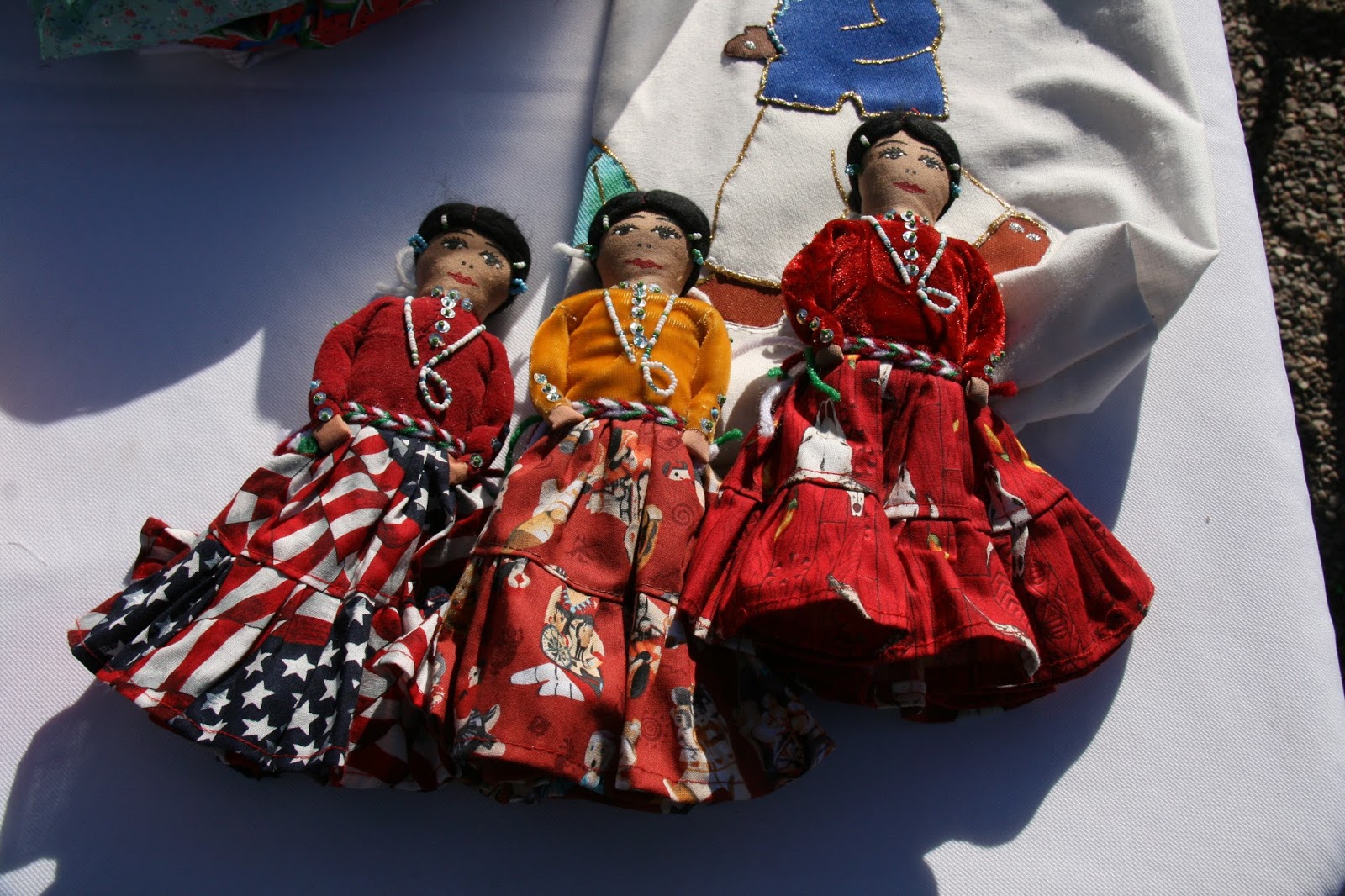
- Navajo dolls made by an elderly Navajo woman. I think these were the best made dolls I have seen. Cost: $10 for a pair
- Large Sterling handmade beaded necklace quickly snapped up by my jewelry artist friend for a reasonable $60.
- Navajo-made two strand necklace with spiny oyster beads reasonably priced at $20 (after I asked for a reduced price)
- The best jerky in New Mexico, according to my friend, was offered in many flavors and went for $5.00 a bag.
- An old cast iron figure of a miner, snapped up by another friend for $10.00
- Sodas and water for 50 cents.
- Local honey
- Navajo tea and herbal cures
- Zuni inlay jewelry
- Horno bread
- Roasted corn
- Delicious-looking tacos, fry bread, tamales, bar-b-que

There were tables with rocks and minerals, antique tools, Navajo traditional clothing, Indian jewelry, antiques, household junque, and several litters of puppies.
Hand made Navajo dolls - $5.00 each.
 People watching was out of this world. It is fun to see what the locals buy and this is a local market, not a tourist market. That is why it was so attractive. The vendors sell primarily to the Native American families from the area. The market had a carnival atmosphere with families walking along eating roasted corn ears, looking at CD's, buying produce and stopping for an early hot lunch.

Recommendations
I highly recommend a visit to the Gallup Flea Market for some local flavor and shopping fun. We all agreed there were bargains to be had. None of us were shy about asking for a reduced price.

Be sure and bring water, a hat and sunscreen. You will be outside. Wear closed toed shoes as it is dusty. And when it rains, people complain of the mud.

Bring cash. Some vendors took checks and just a few took credit cards.

When You Go
The market is located off NM Highway 491 on the East side of 9th Street. It is accessible from I-40. Take exit 20 and head north. Turn right on West Lincoln Avenue, then proceeding to 9th Street, then turning Left and proceeding North up 9th Street, the market is on your rightMap
Parking is free.

 Phone Number: 505.722.9857
Gallup Flea Market Website
Photo Credit: Elizabeth R. Rose